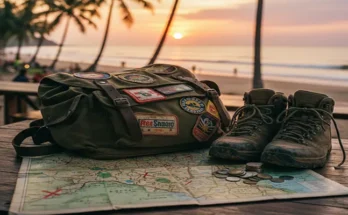

The modern travel industry is a master of illusion. It paints a picture where “global travel” is synonymous with boutique hotels, expensive cocktails on a rooftop in Paris, and pristine suitcases that cost more than a month’s rent. This glossy imagery creates a mental barrier, convincing the average person that they need to wait for a promotion, a lottery win, or retirement to see the world.
But here is the reality: Money is the most expensive way to travel. When you have a thick wallet, you pay for convenience, which often means you are insulated from the very culture you came to see. When you travel with “empty pockets,” you are forced to engage with the world’s true currency: human connection, resourcefulness, and time.
If you have $0 in savings today but a burning desire to cross borders, this is your blueprint.
1. The Survivalist Mindset: Trading Time for Experience
To travel without money, you must accept a fundamental trade-off. In the world of travel, there are two currencies: Cash and Time.
If you don’t have cash, you must be generous with your time. You won’t be taking the 2-hour high-speed train; you’ll be taking the 10-hour local bus. You won’t be staying at a Hilton; you’ll be volunteering four hours of your morning at a hostel. Once you embrace “Slow Travel,” the financial pressure begins to evaporate.
2. The Launch: Getting Out of Your Own Way
Even a “zero-budget” traveler needs a small “Launch Fund” to cover the basics: a passport, a one-way ticket, and travel insurance.
- The Liquidation Phase: Most people sitting on “zero” savings are actually sitting on a goldmine of unused junk. Sell your gaming console, your excess clothes, and that old mountain bike. If it doesn’t fit in a 40L backpack, it’s holding you back.
- The Skill Audit: Before you leave, identify one “on-the-road” skill. Can you cut hair? Can you fix basic tech issues? Are you good with social media? These are tradable commodities in every hostel and village on the planet.
3. The “Free Sleep” Revolution
Accommodation is almost always the highest cost of travel. If you eliminate this, you can stay on the road indefinitely.
- Worldpackers and Workaway: These platforms are the backbone of the budget traveler. You offer a few hours of labor (gardening, painting, reception work, or social media management) in exchange for a bed and food. It’s a 1:1 trade that bypasses the banking system entirely.
- TrustedHousesitters: If you love animals, this is the ultimate hack. You watch someone’s home and pets while they are on vacation. You get a private kitchen, a real bed, and a local neighborhood experience for $0 a night.
- Couchsurfing: Though it has shifted to a small subscription model, the ethos remains: cultural exchange. You sleep on a local’s couch not because you’re a “beggar,” but because you are a guest willing to share your stories and culture.
4. Destination Arbitrage: Follow the Low Cost of Living
You cannot travel to London or Tokyo with no money. To make your journey last, you must head to regions where the local economy is in your favor.
- Southeast Asia (Vietnam, Laos, Northern Thailand): You can eat a gourmet meal for $1.50 and find a bed for $5. If you are working for your room, your daily expenses might be less than a cup of coffee in NYC.
- Central America (Guatemala, Nicaragua): High density of volunteer opportunities and very cheap local transport (the famous “Chicken Buses”).
- The Balkans (Albania, Bosnia and Herzegovina): These are Europe’s best-kept secrets. They offer stunning landscapes and deep history at a fraction of the cost of the Western side of the continent.
5. Generating “Road Money” from Scratch
Eventually, you will need some cash for a ferry ticket or a new pair of shoes. How do you earn it without a traditional job?
- The Digital Nomad “Lite” Route: You don’t need to be a software engineer. Can you transcribe audio? Can you do basic data entry? Websites like Upwork or UserTesting can provide enough “gas money” to keep you moving.
- TEFL (Teaching English as a Foreign Language): This is the ultimate “get out of jail free” card for travelers. Getting an online TEFL certification can land you jobs in schools in Cambodia or Vietnam that often include free housing and a salary that makes you “rich” by local standards.
- Seasonal Working Holiday Visas: If you are under 30 (or 35 for some countries), countries like Australia and New Zealand offer visas that allow you to work for a year. You can pick fruit or work in a cafe, save up $10,000 in six months, and then travel for the next two years.
6. The “Broke Traveler” Toolkit
To survive with empty pockets, you need to master a few specific habits:
- The “Five-Mile” Rule: Never take a taxi. If your destination is under five miles away, walk. You see more, you stay fit, and you save money.
- Eat at the Source: Avoid restaurants with English menus. Go to the local market at 6:00 AM. Buy what the locals buy. Eat where the construction workers and grandmothers eat.
- Water Filtration: A $30 investment in a filtered water bottle (like a Sawyer or LifeStraw) will save you hundreds of dollars on bottled water and prevent thousands of plastic bottles from hitting the landfill.
7. Safety and Ethics
Traveling without money requires a high degree of “Social Intelligence.”
- Don’t Be a “Begpacker”: There is a controversial trend of Western travelers begging for money on the streets of developing nations. Don’t do this. It is disrespectful to the local population. Always trade value (work, skills, or entertainment) rather than asking for handouts.
- Insurance is Non-Negotiable: You might have empty pockets, but you cannot afford a $20,000 bill for a broken leg. Use a subscription service like SafetyWing—it’s designed for this lifestyle and is extremely affordable.
Summary: Your 90-Day Departure Plan
- Day 1-30: Sell everything you own. Apply for your passport.
- Day 31-60: Secure your first “Workaway” or “Worldpackers” placement in a low-cost country. Buy a one-way ticket.
- Day 61-90: Get your vaccinations, set up a fee-free bank account (like Wise or Revolut), and pack your bag.
“Someday” is a disease that will kill your dreams. If you wait until you have “enough” money, you may never leave. The world is surprisingly accessible to those who are willing to be humble, work hard, and step outside the traditional consumerist bubble. An empty pocket isn’t a barrier; it’s an invitation to a more authentic, raw, and transformative way of seeing the planet.